Monday, October 15, 2007 - Iddo Genuth
Home >> Articles >> The Future of X
Thirty-five years in the making, electronic paper is now closer than ever to changing the way we read, write, and study — a revolution so profound that some see it as second only to the invention of the printing press in the 15th century. Made of flexible material, requiring ultra-low power consumption, cheap to manufacture, and—most important—easy and convenient to read, e-papers of the future are just around the corner, with the promise to hold libraries on a chip and replace most printed newspapers before the end of the next decade. This article will cover the history, technology, and future of what will be the second paper revolution continue reading

Thursday, October 25, 2007
The Future of Electronic Paper


Saturday, October 20, 2007
Advice to future graduates
On the same shelf:What's an MLIS Worth?
A picture of overall growth is marred by fissures in job outlook
By Stephanie Maatta -- Library Journal, 10/15/2007
"A final question on the follow-up survey—for advice they would give to future colleagues—elicited responses from the philosophical to the practical. But in general, graduates stressed a need to be able to “parlay” personal background into professional experience. They emphasized the need for experience in a library or information agency even if it's in the capacity of a volunteer or page. Additionally, they suggested polishing the professional persona before entering the job market. One advised, “Be sure your MySpace or other social networking web pages are what you want future employers to see. The first thing a department head does when she gets a résumé is google the person.” For those going the corporate route, another advised, “No visible tattoos! Before going to an interview with a reputable firm, take out the face piercings and nose rings. Dye your blue (purple, mauve, or green) hair something 'normal.' Invest in a professionally prepared résumé.” Such professionalism extends to attitude, as expressed in the final piece of practical advice the 2006 graduates issued: “Show your administration that your job is more than just a 'job,' that it is your career.” continue reading the full article
Sunday, October 14, 2007
AMERICAN LIBRARY ASSOCIATION's Education & Careers Section
Make a living making a difference...
Consider joining the 400,000 librarians and library workers who bring opportunity every day to the communities they serve. If you're looking to enter the library profession or furthering an existing career in libraries, the following resources can help you on your way.
Explore a career in libraries:
Interested? Start your library career:
Furthering your library career:
Click here for more info and updates
Includes information for jobseekers, as well as employment resources for existing library workers and human resource professionals.
Love your library career? Use these resources to usher in the next generation of library workers.
Thursday, October 11, 2007
+ Practical Ideas You Can Use to Improve Your Library Program
Text from the AASL 2001 Annual Conference SessionTitle of presentation: 101+ Practical Ideas You Can Use to Improve Your Library Program.
Presented by: Gene Hainer, Colorado State Library and Su Eckhardt, Cherry Creek School District.
(c) 2001, Colorado Educational Media Association and Colorado State Library. Permission to duplicate for educational purposes only, with proper credit to the above authors and organizations. All other rights reserved.
The following ideas were gathered from many sources or personal experience. Some you may want to do now. Others you may never want to do. There may even be things you know about that aren't listed here.
While reading, take a moment to commit yourself to doing something--anything--to improve your library, work life, collection, PR, communication, collaboration, instructional practices. Anything. Then take that first step and try it! If that's successful, try something else. You (and your program) will be better for it.
Categorized by the elements presented in Principles of Information Power: Building Partnerships for Student Learning.
LEADERSHIP1. Realize that you do not have time to do EVERYTHING. Decide what is important and do THAT....
LEARNING AND TEACHING
45. Start curriculum mapping of the classroom content. Work with teachers to sketch out the major curriculum areas or units that they will be working on throughout the year. These can be displayed on poster board (if first laminated, can be written on, erased, and changed as needed during the year). It also reminds teachers that you and the library are there to help with instruction.
PROGRAM ADMINISTRATION
55. Post copyright restrictions. Place on copy machines, VCRs, reproducible notebooks that request permissions, etc.
Continue reading the 101+Practical Ideas You Can Use to Improve Your Library Program
Saturday, October 06, 2007
THE IMPORTANCE OF ERESOURCE STATISTICS
Sarah Houghton-Jan [San Mateo County (California, USA) Library] made a good point in this post on Librarian in Black.
in
eMusic says no to DRM -and- Sarah's lesson on the importance of eResource statisticsHint to Libraries: “Please examine your online resource statistics. When you’re shelling out thousands a pop, it wouldn’t be too much of a burden to make sure those resources are actually being used. Right? You might be surprised that the resources your staff tell you they use all the time are actually the lowest-used in your collection...or what you think might be used, based on instinct, just isn’t. At that point, you have to ask yourself why, and make adjustments in PR, staff training, staff promotion of the resources to the public, and look at the barriers to access on your website or the vendor’s site. See if the numbers rise after making some changes, but give it at least 6 months; it will take time.”
URL: http://librarianinblack.typepad.com/librarianinblack/2007/10/emusic-says-
info courtesy: Judith A. Siess @ OPL Plus (not just for OPLs anymore)
Monday, October 01, 2007
Enhanced Speed Reading
PS. Interesting application news @ Factiva's "Researcher", info courtesy: Daniela Barbosa and Daniela says: "As promised on Lou's original post, Greg writes about some of the tools that he has been experimenting with which provide capabilities that he is calling 'enhanced speed reading'. His thoughts are based on conversations with information professionals and researchers about how to effectively manage the ever increasing volume of information they need to read."
The following is from Greg's blog:
The following is from Greg's blog:
Concorder Pro: This tool is a bit buggy but I still use it to navigate mini text archives using concordance to browse by words alphabetically or by count. Once you get beyond stop words, it gets very interesting. This app was last updated in 2003 and for OS X mac only. Concordance provides the word counts for every word my mini archive.
Other tools that are also very interesting include:DEVONagent
Concept Q
RefVis
When considering the professional researcher we not only talk about expert search strategies but how the results are really used. Who scans, reads, annotates the ever-increasing overload of relevant information.

Sunday, September 23, 2007
Librarian faces racism at trial if extradited, lawyer tells court
Sep 22, 2007 04:30 AM
Peter Small
Courts Bureau, TheStar.com
A Toronto librarian accused of shooting a white police officer in Chicago almost 40 years ago should not be extradited to face trial in the U.S. because as a black man, he won't get a fair trail, his lawyer has told three appeal court judges.
"Black men in the United States have been victims of persecution for centuries and that includes to the present day ... including state authorities in Chicago," John Norris argued yesterday.
Canada's justice minister turned a "blind eye" to this deep-rooted racism when he ordered Joseph Pannell to be surrendered for extradition, Norris told the panel.
But federal Crown counsel Janet Henchey countered there would be no particular risk to Pannell due to U.S. racism. "Frankly, there is racism in Canada."
Pannell, 58, has been in jail since July 2004, when he was arrested at gunpoint as he left his job at the Toronto Reference Library. continue reading
Peter Small
Courts Bureau, TheStar.com
A Toronto librarian accused of shooting a white police officer in Chicago almost 40 years ago should not be extradited to face trial in the U.S. because as a black man, he won't get a fair trail, his lawyer has told three appeal court judges.
"Black men in the United States have been victims of persecution for centuries and that includes to the present day ... including state authorities in Chicago," John Norris argued yesterday.
Canada's justice minister turned a "blind eye" to this deep-rooted racism when he ordered Joseph Pannell to be surrendered for extradition, Norris told the panel.
But federal Crown counsel Janet Henchey countered there would be no particular risk to Pannell due to U.S. racism. "Frankly, there is racism in Canada."
Pannell, 58, has been in jail since July 2004, when he was arrested at gunpoint as he left his job at the Toronto Reference Library. continue reading
Sunday, September 09, 2007
LIGHTSPACE: Paradigm Shift in Education
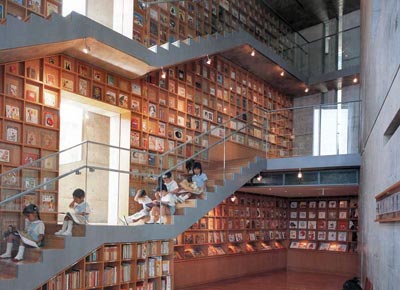
"In my student days I studied in some of the world’s most renowned libraries, such as the awe-inspiring library of the British Museum, — where supposedly the dream and the horror of communism was born —, or the much smaller library of Mackintosh’s Fine Arts School in Glasgow. Their difference in size was immense, but there was a common denominator shared by almost all the classical style libraries: that was their dark atmosphere, dim spot lights only, hardly any sound, only whispering; visually you were surrounded by stacks of mostly leather bound and dusty books looking all very ancient. Both buildings were center oriented, inward looking only. You were meant to be glued to your seat over your book. One had the feeling of being in a monastic setting with ancient editions of the Bible, the Greek tragedies and other heavy volumes of sacred wisdom. One wasn’t allowed to speak, forget about laughing. Libraries were conceived as castles of learning, education and ancient wisdom, as if education by default had to be directed backwards. And above all, the accent was on seriousness.
The results of this cloistered and serious paradigm of human learning, whether in the dark halls of Oxford, Harvard or Berlin, ultimately sanctioned by the “religions of the book” from 2000 to 2500 years ago and not derived from “religions of personal experience”, are not encouraging: the 20th century was the bloodiest in human history, and the 21st promises to beat the gruesome record. continue reading Architecture of the Month: 2006 April
"
Subscribe to:
Posts (Atom)