While there are a number of books that help in resource discovery (aka cataloging / cataloguing), this book has more hands-on and how-to-do in dealing with both AACR2 and (RDA)
Describing Electronic, Digital, and Other Media Using AACR and RDA: A How-To-Do-It Manual for Librarians (How-to-Do-It Manuals), by Mary Beth Weber, Fay Austin, Facet Publishing and Neal-Schuman Publishers, Inc.; Pap/Cdr edition (2011)
Extract:
Catalogers hungry for hard-to-find answers regarding the best way to insure access to diverse new content will find expert solutions in this vital new resource. Streaming video, Internet sites, dual-disc DVDs, blogs and listservs are just some of the rapidly emerging, and often complicated, new resources covered in this current, easy-to-follow manual. Authors Mary Beth Weber and Fay Austin dedicate separate chapters to each non-print and e-resource format, and include corresponding examples to help demonstrate practical implementation of these critical new skills. A companion CD-ROM contains fully-worked out examples, models and illustrations, and acts as an important visual guide to help reinforce key concepts. Practical and user-friendly, this essential guide to 21st century cataloging will teach you to organize your constantly expanding collection of materials with both optimal efficiency and increased discoverability.
What do Reviewers Say:
With a useful CD-ROM for step-by-step help and a companion website that will be updated as necessary. Recommended." --Library Journal, April 2011
"This book is highly recommended for technical services staff struggling with changing cataloguing rules for certain types of nonbook materials." --Technicalities, November/December 2011

Showing posts with label Virtual Libraries. Show all posts
Showing posts with label Virtual Libraries. Show all posts
Monday, July 02, 2012


Friday, October 10, 2008

Thursday, February 07, 2008
Library 2.0: Based and Debased
It is heartening to see that Library world is adapting the word: Library 2.0--adapting the word sounds more apropriate because adapting the technology & / or technique of Web 2.0 is not so much obvious. The Word-base is growing, at least if the following is any trend in a Web directory:
Home : Libraries : Library and Information Science : Weblogs : Directories Links:
BlogBib: Select
Librarian/Library Blogs - Annotated list.
BloggingLibraries - Lists by library type, from blogwithoutalibrary.net.
Library Weblogs - Directory categorized by geographic location, compiled by Peter
Scott.
RSS(sm): Rich
Site Services - A categorized registry of library services that are
delivered or provided through RSS/XML, Atom, or other types of web feeds.
The Blog - Overview of blogging for librarians by Rachel Mathieu and Robyn
Fleming. Includes a directory of library blogs.

Also read:
- Library 2.0 Debased by John Blyberg @ blyberg.net [info courtesy: Dr. Francis J Devadason]
- How to find out the best combination of web 2.0 tools and their suitable Library applications, About This Discussion

Started Jan 6 by: F.J.Devadason

NB. Ask for more info about my own presentation on Web 2.0: Challenges for libraries.
Thursday, October 25, 2007
The Future of Electronic Paper
Monday, October 15, 2007 - Iddo Genuth
Home >> Articles >> The Future of X
Thirty-five years in the making, electronic paper is now closer than ever to changing the way we read, write, and study — a revolution so profound that some see it as second only to the invention of the printing press in the 15th century. Made of flexible material, requiring ultra-low power consumption, cheap to manufacture, and—most important—easy and convenient to read, e-papers of the future are just around the corner, with the promise to hold libraries on a chip and replace most printed newspapers before the end of the next decade. This article will cover the history, technology, and future of what will be the second paper revolution continue reading

Sunday, August 19, 2007
ALA Tool Kit for the Expert Web Searcher
Developed and maintained by Pat Ensor
Tired of endless lists of Web search tools that give you no guidance as to which ones to use? Or that were last updated when Gophers were alive? I'm inviting you to look over my shoulder and use what I use every day for Web searching in an academic library. I keep up with this stuff so you don't have to! continue reading
Tuesday, August 14, 2007
Top Ten Facebook Apps for Librarians
Part One @ iLibrarian & OEDb
Librarians are experimenting with a wide range of Facebook Apps ranging from the productive such as the 30 Boxes Calendar, Meebo, Twitter, and Zoho Online Office to the silly with Zombies, Likeness, My Aquarium, and SuperPoke. Here are the first three Facebook Apps designed for the librarian in all of us:
Books iRead – With nearly 200,000 users, this handy app claims to be the most popular book application on Facebook. .
LibGuides Librarian – For those of you using Springshare’s LibGuides subject guides maker for libraries, you’ll be pleased to see this new app which lets you display your guides in your Facebook profile and also provides a search of your library’s catalog.
Librarian –This virtual librarian service provides links to books, scholarly sources, and reference resources which the community can add to and vote on. Those who access this application can access an “Ask a Librarian” service, as well as customize and build their own widget based on the original. Continue reading

Wednesday, July 25, 2007
Reference Books Bulletin: Is Print Reference Dead?
Extracts:
Reasons why print is dying:
- Catalog information for p-titles is limited to title in most cases
e-ref is very browsable online--TOC, indexes, etc. - Preferences of contemporary users who expect 24/7 access, searchability, full text delivery.
- P-content is invisible
- Print indexes are too hard to use
- MLS/MLIS students are not required to take reference. Most get out of school with only one (or fewer) ref classes
- Print is....print. E-resources offer interactivity and multimedia. Many resources are dynamic and frequently updated
Monday, July 16, 2007
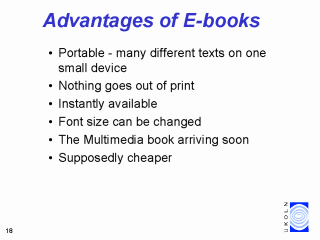
What are the advantages of e-books over print books

punchline:
3.2.6i: Why Librarians would like to purchase more e-books and encourage greater use of them, and their concerns
3.2.6ia: Access
3.2.6ib: Stock Maintenance and Administrative
Tasks
3.2.6ic: Quality of Stock
3.2.6id: Economic Considerations
3.2.6ii: Librarians’ prioritisation of e-book acquisition, with reasons
3.2.6iia: High demand
3.2.6iib: Material types sought
3.2.6iic: Target subjects
3.2.6iid: Specific user groups
3.2.6iie: Constraints
continue reading: What are the advantages of e-books over print books
see also:
Saturday, June 23, 2007
Library 2.0 - This network is for Library 2.0 Stuff
This network is for librarians and others interested in Library 2.0.
Monday, May 28, 2007
Saturday, April 07, 2007
Nine Questions on Technology Innovation in Academic Libraries
In February, 2007, an invitation to an informal survey of "Nine Questions on Technology Innovation in Academic Libraries" was posted to the WEB4LIB, NGC4LIB, LITA-L, COLLIB-L, ACRL-NJ and New Jersey academic library listservs, and it was mentioned in the national ACRLog blog.
The following is a brief summary of the informal survey results with links to more complete information:
***
The survey received 136 responses in total, and 75% said that their library is not the center of technology innovation on campus, while 23% identified the library as the center of technology innovation on campus.
Overall, the majority responded that:
*Recent technology innovations in the library included blogs, wikis, RSS feeds, IM reference, and digitization projects.
*The driving force behind tech. innovation is student needs, followed by an Information Tech. Chief or Dean with vision, and the initiative of individuals.
*The biggest obstacle to tech. innovation in libraries is lack of money, staff, and time, with an unsupportive administration cited as one of the top four obstacles.
*The Library's approach and the Library staff's approach to technology innovation were both overwhelmingly described as "cautious but willing," though the staff were more often described as "resistant and blocking" than the Library itself.
*Faculty and librarians were most cited as the introducers of disruptive technology on campus, followed closely by students.
*The most disruptive technology for academic libraries today is "Web 2.0" or Social Computing technologies with Google/Google Scholar coming up second.
*The Top Ten Models of Technology Innovation cited by the libraries that answered that their libraries are centers of technology innovation were very similar to those cited overall. The Top Ten Models identified were:
1) North Carolina State University – Endeca Project
2) University of Pennsylvania - PennTags
3) MIT – DSpace
4) University of Michigan – Digital Library Production Service (DLPS)
5) University of Minnesota – Primo library system
6) Cornell University – Digital Library Research Projects
7) University of Virginia – Fedora Open Source Institutional Repository 8) University of California – California Digital Library (CDL)
9) University of California, Santa Barbara - Alexandria Digital Library Geospatial Network
10) Oregon State University – LibraryFind Project
For more information on these Top Ten Models of Tech. Innovation in Academic Libraries, links and abstracts are posted on the ACRL-New Jersey Chapter Website
Separate analyses for the libraries that answered "yes" they are the center of technology innovation and the libraries that answered "no"
The overall quantitative results of the survey and the text of the nine
questions are posted online
NB. Info courtesy: Mary A. Mallery @ [Web4lib] & College Libraries Section [COLLIB-L@ala.org ]
Technorati tags:
ACRL
college and research libraries
Friday, April 06, 2007
Mattering in the Blogosphere

"American Libraries asked 16 much-visited librarian bloggers why the medium continues to appeal to them and what keeps them posting. The 10 who replied are, in alphabetical order:"
Blake Carver, LISNews Nicole Engard, What I Learned Today Rochelle Hartman, Tinfoil+Raccoon Sarah Houghton-Jan, Librarian in Black Jenny Levine, The Shifted Librarian Kathleen de la Pena McCook,Librarian at the Kitchen Table Mary Minow, Library Law Joshua Neff, Goblin in the Library Jack Stephens, Conservator Jessamyn West, Librarian.net
PS. All-of-the-above information courtesy: Tinfoil + Raccoon's Blog
American Libraries, March 2007
Saturday, March 24, 2007
Go to the library - ways to survive life without the Internet
An online search may be fast and effortless, but there is nothing like a reference library to make you really appreciate the world of knowledge. Surround yourself in books and get a taste of what it was like to engross yourself in research before the Internet. The process is far more challenging and rewarding." Source: 7 ways to survive life without the Internet
And, Then The Life Will Be As-Is:


"...the Web’s days are numbered as the Internet moves to a second round of expansion beyond the browser... continue reading"
Thursday, March 15, 2007
Provision of Medical Information - Ask Cosmo, NLM’s Virtual Representative!

Al Reynolds [ecumenical77 at earthlink dot net] wrote:
1. "Ask Cosmo" is an automated answer-my-question site at http://wwwns.nlm.nih.gov/
Many questions from the general public can be answered by Cosmo the Owl.
2. Questions may be directed by telephone at the following numbers:
(888) FIND-NLM
(888) 346-3656 Local and international calls:
(301) 594-5983
-------------------------------------------------
Background note: NLM usually received from 200 to 500 requests per day when I was there. Some were library questions ("How to I use PubMed?") but many were cries for medical help ("My daughter has cancer and the medicine isn't working, what can I do?").
I served on the Customer Service staff of the National Library of Medicine for two years. Such questions are constantly being directed to NLM as a free and reputable source of medical information.
There are 7 or 8 full time staff members tasked with responding to such questions. Of course we are not clinicians, so we provide information found on such sites as MedlinePlus and PubMed, and we use directory sites, advocacy organizations and professional associations quite heavily.
You or your patrons may address queries to: custserv@nlm.nih.gov
A response will be sent within 4 working days. NLM does not send printed materials.
During my two years I worked messages originating in 106 countries.
Al Reynolds
Reference Assistant
Frederick Memorial Hospital
Frederick, Maryland
Former contractor at U.S. National Library of Medicine
P.S. This information is disseminated with permission from Al Reynolds.
From the Blogosphere:
Wednesday, February 14, 2007
Wikipedia and Academia Hit News Headlines Again
Poor Wikipedia. Professional Golfer Fuzzy Zoeller is suing one of its contributors for a defamatory cyber-attack. And last year, television host and comedian Stephen Colbert urged his audience to vandalize a Wikipedia entry about elephants to prove the point that in a model where any user can edit encyclopedia entries, those entries are only as good as their source. Look Who's Using Wikipedia, Mar. 01, 2007, By BILL TANCER, Time / CNN [info courtesy, David Dillar]

Current News Stories:
"...places like the blogosphere or the online encyclopaedia Wikipedia, people no longer treat or respect each other as individuals." Web 2.0's 'digital mobs' attacked: Jaron Lanier tells BBC World Service's Culture Shock

Middlebury: Middlebury College history students are no longer allowed to use Wikipedia in preparing class papers.
The school's history department recently adopted a policy that says it's OK to consult the popular online encyclopedia, but that it can't be cited as an authoritative source by students.
The policy says, in part, "Wikipedia is not an acceptable citation, even though it may lead one to a citable source."
History professor Neil Waters says Wikipedia is an ideal place to start research but an unacceptable way to end it. Read another source
As Wikipedia has become more and more popular with students, some
professors have become increasingly concerned about the online,
reader-produced encyclopedia.
From News Archives:
The other side of the coin:
Related resources:
My previous posts:
Tuesday, September 26, 2006
Infostructure Tools - eRider Starter Kit
eRider Starter Kit
July 2005
Tactical Technology Collective
A guide to starting, managing, and running an eRider project has been released by the Tactical Technology Collective with funding from OSI's Information Program.
A movement of technology assistance providers working in developing and transition countries has been emerging since 1997. Known as eRiders, their work is based on the Circuit Rider model used successfully in the United States to provide nonprofit organizations with assistance in using technology to build capacities. The eRiding model has been effectively used internationally to bring struggling organizations up to speed in the use of technology to fulfill their mission.Continue Reading...
Thursday, September 21, 2006
Pull and Push Communications: Ranganathan's Laws re-interpreted
I strongly feel that Ranganathan's Second and Third Law of Library Science have a direct relationship with pull and push communications strategies. A clarification on this is necessary (to avoid any clash of ideas). There is a bit of overlap in the implications of these two laws. This overlap may sound logical, because, the Second Law is about the choice of information (including seeking behavior and end-user's priorities), and the Third Law is about the choice of medium (including skills) for outreach of the message.***
In short, in both these situations, whether you try to pull or push, you are aiming at establishing a network between the messenger, message, medium and end-user--albeit, with a balance (lest, the Guru, Marshall McLuhan said, message is lost in the medium)
And, here is an excellent piece on the pull strategies, in relation to library marketing situations:
In communications there are two primary models for reaching target audiences. One is called "pull" communications and the other is called "push" communications. We'll outline pull communications now, and in the next issue of Marketing Treasures, we'll talk about push communications.
In talking about the push and pull models, we are not referring to the underlying technology such as RSS, but instead, on the user experience. To embark upon a pull communications strategy is to allow members of your target audience to "pull" your communications at their discretion. In the brick and mortar world, pull communications are used by advertisers to draw customers into retail establishments to receive messages. People elect when and how they will act on the messages in the pull model of communications. In the virtual world, pull communications is exemplified by blogs, wikis, and web sites. Continue reading Marketing Treasures July 2006
Related approaches to understand Web, Marketing and the nexus:
1. The Law of Dead--End Street
2. The Law of Giving and Selling
3. The Law of trust
4. The Law of Pull and Push
5. The Law of the Niche [continue reading [pdf]]
... should therefore be seen to some extent as reflecting the ‘Pull-Push Effect’ of ... Ranganathan who infused scientific method in the field and that marked ...
I am going to suggest that Ranganathan's five laws are as valid today and ... of automated push and or pull services from libraries and from a distance. ...
See my other posts:
--------
*** Thus spake the Law Giver, Ranganathan:
Second Law: Every Reader His or Her Book
Clearly, it is the business of librarians to know the reader, to know the books, and to actively help in the finding by every person of his or her book.
Third Law: Every Book its Reader
This law addresses the fundamental issue of open access. Open access means that the collection can be examined with as much freedom as if it was the reader's private library.
Source
Prof. A. Neelamgehan was kind enough to add a few words to this post:
Dear Dr. Md. Taher:
As you are aware in most library’s only about 75% of the collection get used frequently. Dr.S R Ranganathan’s Third Law is more concerned with those documents that are not frequently used; what measures that the library / librarian should undertake to push and bring those items to the potential users’ attention – including special exhibitions, lectures by scholars about these resources, etc.
Best wishes
A. Neelameghan
Thursday, September 07, 2006
Infostructure Conferences
This will be a running post: Updated 6 Sept., 2006
Here, infostructure, is used in context of the a) digital libraries and b) search process (capturing, seeking, searching, browsing, matching, finding, sorting, storing, retrieving, etc.). Infostructure, all-ado-about information, per se, is much more important, than the infrastructure (aka technology).
Infostructure is gradually emarging with new faces, interfaces in today's information society.
DRTC/ISI announces International conference on Semantic Web and Digital Libraries. February 21-23, 2007 at Bangalore, India. contact details:
Report of 2006 Search Engine Meeting, by Martin White, @ The Intranet Focus:
SHARP 2007 Conference: "Open the Book, Open the Mind,"
The fifteenth annual conference of the Society for the History of
Authorship, Reading, and Publishing (SHARP) will be held in Minneapolis
at the University of Minnesota on July 11-15, 2007. SHARP is the
leading international association for historians of print culture, enlisting
more than 1,200 scholars world-wide; its members study "the creation,
dissemination, and reception of script and print, including newspapers,
periodicals, and ephemera," as well as the history of books. The
forthcoming conference is organized in cooperation with the College of
Liberal Arts, University of Minnesota; University of Minnesota
Libraries; Minneapolis Public Library; Minnesota Historical Society,
and Minnesota Center for Book Arts -- a part of Open Book.
My previous posts:
Searching Revisited: Horizontal, Vertical, Diagonal, etc.
Searching Is Polarized; Will The Five Laws Get a New Revised ...
Visualizing the Web Infostructure I - Cites, Insights, Farsights
Visualizing the Innernet or Visual Display of the Website's Infostructure
Market Research Resources via Libraries
Book review from my desk:
Mary Ellen Bates. Building & running a successful research business: a guide for the independent information professional. Edited by Reva Basch. CyberAge Books, 2003 -- (new edition: Building & running a successful research business: a guide for the independent information professional, 2010) Information Resources Management Journal
Technocrati tags:
Internet Industry, Information Industry, infostructure, information society, Return On Investment, ROI, libraries, AltRef, Ubiquitous Reference, Reference Service
Google: Infostructure Conference
Infrastructure Conference
Here, infostructure, is used in context of the a) digital libraries and b) search process (capturing, seeking, searching, browsing, matching, finding, sorting, storing, retrieving, etc.). Infostructure, all-ado-about information, per se, is much more important, than the infrastructure (aka technology).
Infostructure is gradually emarging with new faces, interfaces in today's information society.
A.R.D.Prasad
Convener, ICSD -2007
Documentation Research and Training Centre,
Indian Statistical Institute,
8th Mile, Mysore Road, Bangalore - 560 059
Karnataka, INDIA
Phone: 91-80-28483002/3/4 extsn no. 496
Fax : 91-80-28484265
email: ard@drtc.isibang.ac.in
website:http://drtc.isibang.ac.in/DRTC/ardcv.html
Until the recent arrival of the Enterprise Search Summit the Infonortics Search Engine Meeting was the conference to attend if you wanted to track what was happening in the technology and business of search. ...
Many of the papers at the conference were concerned with how to effectively search 'the long tail' a major issue in enterprise search because a searcher has to be confident that they have found all relevant documents, not just a sample. Which leads me neatly into an excellent paper by Steve Arnold on the way in which search engines are 'managing' relevance. An essay based on his presentation is an essential read. Steve may have slightly overstated the case, but not by much.
The main sessions at the conference were on Searchers and Search Behaviour, Faceted and Federated Search, Text Mining, the World of the Web and finally Web Tools and Intelligent Tools. Virtually all the papers (but not the Google paper) can be downloaded but many are quite substantial files. Continue reading
The fifteenth annual conference of the Society for the History of
Authorship, Reading, and Publishing (SHARP) will be held in Minneapolis
at the University of Minnesota on July 11-15, 2007. SHARP is the
leading international association for historians of print culture, enlisting
more than 1,200 scholars world-wide; its members study "the creation,
dissemination, and reception of script and print, including newspapers,
periodicals, and ephemera," as well as the history of books. The
forthcoming conference is organized in cooperation with the College of
Liberal Arts, University of Minnesota; University of Minnesota
Libraries; Minneapolis Public Library; Minnesota Historical Society,
and Minnesota Center for Book Arts -- a part of Open Book.
My previous posts:
Book review from my desk:
Mary Ellen Bates. Building & running a successful research business: a guide for the independent information professional. Edited by Reva Basch. CyberAge Books, 2003 -- (new edition: Building & running a successful research business: a guide for the independent information professional, 2010) Information Resources Management Journal
Technocrati tags:
Internet Industry, Information Industry, infostructure, information society, Return On Investment, ROI, libraries, AltRef, Ubiquitous Reference, Reference Service
Google: Infostructure Conference
Infrastructure Conference
Monday, August 21, 2006
The Ubiquitous Reference Service & Return On Investment
Reference Service is being challenged by twain: viz. invisible technologies and end-users' need for information everyware. What is this all about?
For an answer see the creative visulation, The Ubiquitous Reference Model by Brian Mathews at Georgia Institute of Technology
A comment on this model from The Distant Librarian (i.e., Paul R. Pival)'s mind, gives you a direct lead on what is the impact of this ubiquitousness:
He created an account at Xanga and LiveJournal - first as a library, but later as his human incarnation. For the purposes of his study he subscribed to the RSS feeds of 20 GT student blogs at those sites (explained in the paper). But what he's done that seems really innovative to me is that he's using the Bloglines keyword alert feature to monitor the postings in each of those student blogs for words such as assignment, library, help, paper, project, etc.
And this gets to the core of Brian's thinking that "we need to get out from behind the desk and help students when and where they need it." Surely in your physical library you don't just wait at the reference desk for poor souls to come to you. Every once in a while you wander around the computers, and even occasionally offer assistance to someone who looks obviously lost, right? What do you think of this idea?
Punch Line:
It never ceases to amaze as to what professionals in the internet
industries do not know about bibliographic databases and website
indexing sources on the internet that are free to the entire public." David Dillard
From the Future of Reference Services Papers:
A decade ago I posited a Sixth Law, an extension of S.R. Ranganathan's Five Laws of Library Science. At the time I conceived that Sixth Law--"Every reader his freedom"--as applicable only to the type of service (i.e., instruction or provision of information). Today it also applies to the mode of delivery-in-person, telephone, online-and tomorrow to holographic interactions and 3-D virtual reality ...
We have been serving the "Net Generation." The students who entered college as 18-year-olds in 1993 were entering Kindergarten when the Nintendo craze swept the nation. They could barely remember a time that they did not interact with and control images on a screen. Every year since then our entering students have brought with them greater comfort with technology as well as greater confidence, justified or not, in their ability to use it well. We are now serving the IM (i.e., instant messaging) generation. Some of them add SmarterChild to their AOL IM buddies list; they ask it questions, receive guidance to relevant Web sites, and play interactive games of Hangman with SmarterChild. Their familiarity with information technology has spawned values we dare not ignore. Those values are immediacy, interactivity, personalization, and mobility... Continue reading: "Technology, Cluelessness, Anthropology, and the Memex: The Future of Academic Reference Service," by James Rettig
See also my previous post on Search Engines and Information Professions
Technocrati tags: Internet Industry, Information Industry, infostructure, information society, Return On Investment, ROI, libraries, AltRef, Ubiquitous Reference, Reference Service
Friday, August 18, 2006
Information Literacy (for all) - A useful gateway
One-stop Shambles Information Skills and Literacy Page
contents include:
| Copyright and Plagiarism in Education | elearning | How much information in the World? |
| Info Literacy Articles | Info Literacy and Assessment | Info Literacy Definitions |
| Info Literacy History | Info Literacy general | Info Literacy Staff,School, Authority Websites |
| Information Sciences | Teaching Info Literacy | Info Literacy Models | Info Literacy Resources |
| Info.Mngmnt Software | Info.Tech. ICT | Knowledge Management | Library and Librarian |
| Questioning | Research Skills | Study Skills | Evaluating Online Materials | Eval. Books |
| Hoax Websites (maybe) | Learning Styles | Doing a Literacy Review | Media Studies | Mindmapping |
| Technology Literacy | Time Management | Visual Literacy | Web 2.0 | 21st Century Education |
| Almanacs | Aerial & Satellite Images | Ask an Expert | Calendars | Biographies |
| Encyclopedias, Dictionaries and Thesauruses | Finding People | Homework Help | Images |
| Just FACTS | Maps and Atlases | News Online | Online Databases | Online Libraries |
| Online Museums | Online Newspapers | Online Zoos | Quotations |
| (Child) Safe Search Engines and Directories | Search Engines and Directories | Sounds and Music |
| Timelines | Topics | Visual Search Tools | Voices and Sounds | Weather |
© copyright, The Education Project Asia
The following are single recommended search engines for individual subject areas suitable for schools and students,
iif you know of any others to recommend then please email me the details.
| Arts (dance,music,theater,visual arts) | Geography | History | Design & Technology | Food |
| Librarians | Mathematics | Music | Physical Sciences | Science |
NB. This page is cited at
--
Don't miss this:

K. Jane Burpee, Manager, Reference and Information Literacy, Peter Wolf, Manager, Instructional Development, Teaching Support Services, University of Guelph.
Good information skills are essential for successful professionals.
Early in your career you must successfully study and digest a huge volume of information, simply to become effective. As you become increasingly successful, you will need to assimilate a vast number of documents, data and reports, as well as all the information you need to keep up-to-date in your field.
Subscribe to:
Posts (Atom)