Showing posts with label Collection Development. Show all posts

Tuesday, October 14, 2008

Collection Development or Collection Building


Name (what's in a name, anyways): Collection Building is not a preferred term, rather Library of Congress has the blessings for Collection development (Libraries)

I am reading this book: Crash Course in Collection Developme...
Wayne Disher (2007).
This book looks interesting, educating and detailed. It must be a
required reading for library science students as well librarians
searching for meaning in their chosen specialization by the type of
library (oops! the book's orientation is towards
a public library).

See also on the same shelf:
20 Maxims for Collection Building - 9/15/2007 - Library Journal
Contemporary collection development involves art, science, and business.
By Barbara Genco, as told to Raya Kuzyk

Facet 1: EMPOWERED PATRONS
>1 The user and the ILS > 2 Security and self-check > 3 Tagging, not MARC? >

Facet 2: MOBILITY AND DIGITIZATION
> 4 It's content, not containers, Stupid! > 5 Moving materials smarter > 6 Off-site storage and digitization > 7 Downloadable and digital

Facet 3: TRANSPARENT HOLDINGS
> 8 Power of the OPAC > 9 Logistics and process design are key > 10 If it's not cataloged, it doesn't exist > 11 “One big library”

Facet 4: RESPONSIVE ADMINISTRATION
> 12 Fewer librarians, more parapros? > 13 Measuring productivity, use, and needs > 14 Reference is dead; long live reference > 15 Policies are still primary

Facet 5: E-CONTENT AND THE WEB
> 16 It's a Google world > 17 Licenses and government documents

Facet 6: STREAMING SELECTION
> 18 Improving vendor relations > 19 Staying out front > 20 Libraries: The long tail writ large

Continue reading the article @ Library Journal

Monday, July 16, 2007

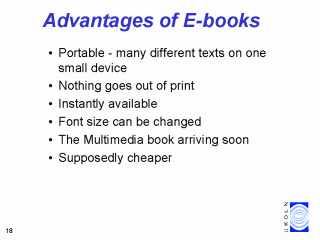
What are the advantages of e-books over print books


punchline:

3.2.6i: Why Librarians would like to purchase more e-books and encourage greater use of them, and their concerns
3.2.6ia: Access
3.2.6ib: Stock Maintenance and Administrative
Tasks
3.2.6ic: Quality of Stock
3.2.6id: Economic Considerations

3.2.6ii: Librarians’ prioritisation of e-book acquisition, with reasons
3.2.6iia: High demand
3.2.6iib: Material types sought
3.2.6iic: Target subjects
3.2.6iid: Specific user groups
3.2.6iie: Constraints
continue reading: What are the advantages of e-books over print books

see also:
  • Advantages of E-books www.ukoln.ac.uk
  • The Benefits and Advantages of Ebooks By Remez Sasson
  • advantages of ebooks
  • Google for more
  • Saturday, March 24, 2007

    Go to the library - ways to survive life without the Internet

    An online search may be fast and effortless, but there is nothing like a reference library to make you really appreciate the world of knowledge. Surround yourself in books and get a taste of what it was like to engross yourself in research before the Internet. The process is far more challenging and rewarding." Source: 7 ways to survive life without the Internet

    And, Then The Life Will Be As-Is:


  • Internet and the Future,
    "...the Web’s days are numbered as the Internet moves to a second round of expansion beyond the browser... continue reading"
  • Living beyond Internet, by VAISHNAVI SUBRAMANIAN - Dil Se, The Hindu, Aug 06, 2007
  • Wednesday, February 14, 2007

    Wikipedia and Academia Hit News Headlines Again

    Poor Wikipedia. Professional Golfer Fuzzy Zoeller is suing one of its contributors for a defamatory cyber-attack. And last year, television host and comedian Stephen Colbert urged his audience to vandalize a Wikipedia entry about elephants to prove the point that in a model where any user can edit encyclopedia entries, those entries are only as good as their source. Look Who's Using Wikipedia, Mar. 01, 2007, By BILL TANCER, Time / CNN [info courtesy, David Dillar]


    Current News Stories:
    "...places like the blogosphere or the online encyclopaedia Wikipedia, people no longer treat or respect each other as individuals." Web 2.0's 'digital mobs' attacked: Jaron Lanier tells BBC World Service's Culture Shock

  • Wikipedia not source for papers: College Sify News, Tuesday, 13 February , 2007.
    Middlebury: Middlebury College history students are no longer allowed to use Wikipedia in preparing class papers.
    The school's history department recently adopted a policy that says it's OK to consult the popular online encyclopedia, but that it can't be cited as an authoritative source by students.
    The policy says, in part, "Wikipedia is not an acceptable citation, even though it may lead one to a citable source."
    History professor Neil Waters says Wikipedia is an ideal place to start research but an unacceptable way to end it. Read another source
  • A Wikipedia WIthout Graffiti by CmdrTaco on Wednesday February 07,
  • A Stand Against Wikipedia: Inside Higher Ed, January 26, 2007
    As Wikipedia has become more and more popular with students, some
    professors have become increasingly concerned about the online,
    reader-produced encyclopedia.
  • A Stand Against Wikipedia
  • The Death of Authority?
  • Tricky truths behind Wikipedia By Alex Beam, Globe Columnist | March 12, 2007 [or Stikcy Wiki, in Deccan Chronicle, India]
  • Wiki Etiquette [ Business Week has a good “do’s and don’ts” list for working with wikis. Worth a quick read. ]

    From News Archives:
  • Wikipedia Revisited Cites & Insights: Crawford at Large, March 2007 v. 7 no. 3
  • RERERENCE: ENCYCLOPEDIAS: The Wikipedia and Serious Research
  • Rick's Blog without Clogs: Wiki Picki Poo Poo
  • When it comes to Computer Science, don't reference Wikipedia
  • Wikipedia And Academia in ACRLog - Blogging by and for academic and research librarians
  • Wikipedia "nofollow" aftermath Seth Finkelstein's
  • The Faith-Based Encyclopedia

    The other side of the coin:
  • Wikipedia/Our Replies to Our Critics
  • Criticism of Wikipedia - Wikipedia, the free encyclopedia


  • Related resources:
  • Blogging: A Reliable Academic Source?
  • The academic contributions of blogging?
  • The scholarly content of blogging
  • Academic Blogging Collection

    My previous posts:
  • Citing a Blog, Wiki - Style for bibliographic notes and references
  • Blog As A Teaching Tool

  • Is this yet another Wiki in Library and Information Science
  • Monday, January 08, 2007

    Picture database recognized as "Best Site"

    101 Best Web Sites for Elementary Teachers.
    The International Society for Technology in Education has named a Miami database as one of "101 Best Web Sites for Elementary Teachers." (Media-Newswire.com)
    Valerie A. Ubbes ( physical education, health and sport studies ) created the Children?s Picture Book Database at Miami University in 1995 in partnership with the Miami University libraries.

    The project now provides abstracts for more than 5,000 children's picture books and can be searched by topics, concepts and skills from eight academic disciplines. The key feature of the database is that books are organized by 10-15 key words, not only the few words provided by the Library of Congress. This gives users access to a broader collection of books for specialized purposes, in new patterns for interdisciplinary study.

    The site's usefulness can be judged by the fact that thousands of users from the United States and seven foreign countries log into it weekly. "Googling" Children's Picture Book Database at Miami University, 25,000 links come up, including resource lists maintained by universities, schools, libraries, teacher groups, national literacy organizations and businesses catering to parents. Continue reading

    Saturday, December 16, 2006

    Faith's purchasing power - USA TODAY


    By Cathy Lynn Grossman, USA TODAY 12/13/2006
    GRAND RAPIDS, Mich. — In the beginning was the book.

    Long before Christmas became a retail explosion, before Christian-related toys, doodads and décor became a $4.5 billion industry, faithful Protestants needed their Bibles.

    READING ABOUT RELIGION

    When shoppers read books about religion, here's where they say they're most likely to get them:

    A Christian bookstore: 15.9%
    A general bookstore such as Barnes & Noble: 14.8%
    Borrow from a friend or family: 12.2%
    The public library: 9.2%
    A church library: 5.6%
    Other: 5.1%
    Online retailer: such as Amazon.com: 4.4%

    Source: Baylor Religion Survey
    Continue reading the full story


    Previous post from my blogs:

  • Cyber Worship in Multifaith Perspectives
  • Video for the Voiceless: An Idea for Missionaries - Faithwise Review of the Week
  • Multifaith Stacks: Reading Between the Shelves
  • Thursday, September 14, 2006

    Blog: Vanity Presses or Archives of Human Thought

    Librarians, archivists and other information professionals are getting interested in the debate. Here is one more live discussion:


    Blogs: Vanity Presses or Archives of Human Thought? Nancy McCormack & Paola Durando. COLAJ:
    Canadian Online Library and Archives Journal, Volume 1, Number 1 (2005 ? - )

    Blogs, or weblogs, are a highly popular and influential means of communication. Should librarians enter the blogosphere to better communicate with colleagues and users, or are blogs a waste of time? Nancy McCormack, Law Librarian at Queen's University at Kingston and her colleague Paola Durando, a Health Sciences Librarian at the same institution, argue both sides.


    See my previous posts on an information professional's perpectives:
  • Visualizing Traffic At My Blog Via Mapping The Pathways
  • Visualizing Comments on Blogs
  • Blog-to Show
  • Google Trend - Another Way to Visualize the Blogosphere
  • Blog As A Teaching Tool
  • The Technique of Song and Sound Visualization -- see also: the Laughing Librarian's Blogga song
  • Blogging Spree: Trends in Information Visualization
  • What's a blog - WYSIWYG
  • Monday, August 28, 2006

    Read, Reading and Readership

    What an interesting rhyme ...

    First, from the library and information science perspective:
  • Rules for reading, well, if I followed rules, The Gypsy Librarian:
    Joyce Saricks had a column on the April 1, 2006 issue of Booklist entitled "Rules for Readers--and That Means Librarians, Too!" I read it via the old library routing, which explains why it took me a while to get to it. Now, my two readers know that I pretty much prefer to throw rules out when I can, but I found the article to be a nice affirmation of things I do as a reader. When it comes to reading, I am a bit eclectic, a mixed bag. Sure, there are things I enjoy regularly, but I wander now and then. Since life is short, I don't believe in wasting time on a bad book. Saricks cites Nancy Pearl's 50 page rule. I will usually try to give a book the 50 page chance, but if it loses me on page 25, it's gone. I used to feel a need to read cover to cover. Not anymore. I am now a liberated reader. continue reading
  • At Leisure with Joyce Saricks: Against Rules
    Having written a few months back about rules for readers and readers’ advisors, I’m having second thoughts. Not about the ideas expressed but about the whole concept of rules in relation to readers’ advisory—especially since our field is refreshingly nonprescriptive. One of the reasons for the current renaissance is that librarians who are practicing and writing about readers’ advisory advocate guidelines and suggestions, not rules. continue reading from At Leisure with Joyce Saricks: Against Rules
  • 3-Minute Reader's Advisory Workshop
    February 22, 2002 "3 Minute Reader's Advisory for the harried and hurried Held at Multnomah County Central Library. Presentions by Robin Beerbower, Salem Public Library, Ruth Allen and Allison Kastner, both from Multnomah County Library. Over 70 attended.
  • Five Minute Reads: Libraries hope e-mails entice readers, By ELLIOTT MINOR / Associated Press Writer
    ALBANY, Ga. (AP) — Patrons of the Dougherty County Library get an e-mail each day featuring one or more chapters from a selected book.
    These "five-minute reads" may persuade the readers to check the book out from the library or go to a bookstore and buy it. If nothing else, they can share their thoughts on the book with other readers on the library's Web site.
  • Belgian Librarians Use Love to Get Readers
  • 15 Readers in 30 Minutes (More or Less)
    Once again we've taken advantage of our illicit love affair with RevolutionSF to get a podcast of our recent reading out there on that Internet thing. Give it a listen - each reading only lasts two minutes, so get over yourself already.
  • The Four Ages of Reading Philosophy and Pedagogy: A Framework for Examining Theory and Practice, Jan Turbill
    Rules for journalists, writers, documentation specialists, etc. on readability:
  • BE A LARSONALLEN STAR:
    Write the way people read.
    The 30-3-30-3 guideline:
    30-second reader skims bullets and short lists.
    3-minute reader reads headlines, blurbs, captions and callout boxes.
    30-minute reader reads short articles and searches the publication for more information.
    3-hour reader wants white papers, research results… hefty reading material. keep reading about readership
  • Joint Board and Budget Committee Agenda:
    the 30-minute reader who will read the full text,
    the 3 minute reader who scans the material, and
    the 30-second reader who reads only the headings as they put it in the trash. keep going here
  • Module 1: NEWS REPORTING AND WRITING:
    Begin your discussion of news writing with a consideration of the different kinds of newspaper readers. For the sake of argument, we can identify three: the 30-second reader, the 3-minute reader, and the 30-minute reader. All of us fall into each of these categories at one time or another.
    The 30-second reader is in a rush, possibly grabbing a quick look at the paper while eating a donut and rushing out the door to school or work. This reader has time only to scan a few headlines and glance at a few pictures.
    The 3-minute reader is also in a rush, though she may have time enough to sit down while she looks at the paper. This reader does all the things that the 30-second reader does, plus she reads the beginning paragraphs (the leads) of a few interesting stories.
    Finally, the 30-minute reader (get a life!) finds time enough to do everything our first two readers did plus actually read a few stories from beginning to end. This is where the importance of inverted pyramid writing (a topic we will cover soon) comes to the fore. continue reading
  • Building Our Talent in a World of Tough Issues:
    "The Internet is for everybody. It's for the 30-second reader; the three-minute reader; the 30- minute reader and even the three-hour junkie. Like the rest of cyberland, though, it's full of branches and nests (and even nests within nests). Open (on home pages, etc.) with kernels for the 30-second reader. Break to bits for the three-minute reader. Branch to detail for the 30-minute reader. Link to verbal and visual feasts for the three-hour junkie." continue reading:
  • Reader advisory network tips
  • Spruce Up Marketing Materials with the 30-3-30 Rule

    See my previous post on Reader's Advisory


  • Sunday, August 06, 2006

    Market Research Techniques for Libraries

    I begin this post with my own effort to create a Webliography on:

    Market Research Resources via Libraries and
    Focus Group Technique for Research on Libraries

    While the above two are extensive sources, I came across a term: Environmental scanning. Googled and found one interesting post in a blog, called, Science Library Pad, by Richard Akerma

    And incidentaly, two different, albeit related resources, inspire me to write this post: First is on Environmental Scanning and the other is ALA's marketing Kit.

    First thing first. Richard identifies the meaning and usage and how this term, environmental scanning (also known as business intelligence, competitive intelligence, etc.), has evolved. Nevertheless, there admit fact that the LCSH does use the subject heading competitive intelligence (and not environmental scanning).

    NB: What surprises me is, there are many citations that have same and / or similar works in the literature (including works that deal with market surveys conducted to assess needs, log analysis to capture the tacit and tangible, etc., community surveys, and so on). If someone coins a term, does it mean that whatever was done in the past is all written off. At least one scholar comes to my mind, not cited by Richard and the OCLC citation, viz., Prof. Chun Wei Choo.

    Based on this random citation behavior and usage of terms that look appealing, I wonder, like all other attempts to be innovative and creative, is this another attempt to present, old wine in a new bottle?

    Any comments? What do the Library Marketing Gurus opine on my note? Any one would like to respond? Does scanning sound, better than research, search, and survey? [search for environmental scanning on the web and you will find medical, environmental, ecological, and other resources. Are we, then, short of terms that we are looking for more?]

    See more on Market Research * libraries

    The second resource, I came across today is:
  • Marketing @ your library, ALA
  • @ your library® Toolkit for Academic and Research Libraries


  • Google for pursuasion, pull, push, in marketing and libraries.
  • Industry Canada. Competitive Intelligence, see also: Competitive Intelligence E-Monitor
    PUNCHLINE:
    Marketing of Evil' opposed by the gay community is locked out of over 99% of college libraries
    The Virginia Tech librarian ran a database search on "The Marketing of Evil" to see how many libraries worldwide had a copy, and came up with some surprising results. He searched WorldCat, an online database of the Dublin, Ohio-based Online Computer Library Center, or OCLC, which is accessed by more than 53,548 libraries in 96 countries and territories worldwide. "According to WorldCat," he said, "only 188 libraries worldwide report owning a copy of 'The Marketing of Evil.' I'm pleased that Virginia Tech is one of only eight libraries in Virginia that reports owning the book. I had requested it because I wanted to read it. One of my colleagues saw to it that it was purchased. We are now pleased to see that it is currently checked out."
    "'Marketing of Evil' locked out of college libraries," World Net Daily, April 26, 2006 --- http://www.worldnetdaily.com/news/article.asp?ARTICLE_ID=49921
    [source: Tidbits on May 5, 2006]
  • Wednesday, August 02, 2006

    Access New York Times Archives ?

    I just read about free access to NYT.

    Legit Trick to Access New York Times Archives for free posted by Amit Agarwal on 7/07/2006

    Has any one tried it? Any success breeding success?

    Tuesday, July 25, 2006

    Collection Development Templates


    What is collection development? What is the need for a template? Some answers are here:
    SOURCE: ANON.

           Finding quality items for your consumer health library can be a challenge. Here are some ideas for adding to your collection. Go to the local Barnes and Noble or Books-A-Million and browse the selection of health books. This is great, because you can actually see the item before you make your purchase or order. Read the customer reviews on Amazon.com. Look at core lists from the Consumer and Patient Health Information Section of MLA at http://caphis.mlanet.org Look in Alan Rees' Consumer Health Information Sourcebook for recommendations.

    Here are some guidelines for evaluating your collection. Are there books older than five years on the shelf? Five years is a general guideline for currency. There should be very few exceptions to this guideline. Even anatomy books become dated. Are there duplicates that are not being used? Conduct an inventory. Are there missing/lost items? Are there some books that probably have newer editions?

    Something that will help you the next time you evaluate your collection is to create a collection development policy for your health collection. Be sure to include the scope of the collection, handling gifts, weeding, and dealing with challenges. Your collection development policy for consumer health should be a separate part of the institutional collection development policy.

    With these suggestions, you will be able to create and manage a consumer health collection:

    ·        Collection Development Policy: Policy Template

    ·        COLLECTION DEVELOPMENT POLICY TEMPLATE

    ·       Guidelines for Writing Collection Development Policies

    · A Practical Approach to Writing a Collection Development Policy
    see also: Procedures enforcing the collecting policy

    Saturday, July 15, 2006

    Practical Tips for Buying & / Or Selling Books

    How to sell a book, with so much competition around. And, where to buy a book amidst so many stores? I found two sources, and I am posting these here:


    Selling a book:
    Rules of thumb for booksellers

    There’s a copy of Susan Halas’ rules of thumb for booksellers buying books (to resell) over at the Bibliophile Bullpen. Interesting stuff.
    Some samples:
    Q: You are looking through hundreds of cheap paperbacks for something of value, what are you looking for?
    A: Size smaller, the older paperbacks were a little bit smaller than the current size, you can see it on the shelf, look for the one(s) that are shorter. Cover price — the lower the cover price the earlier the issue. Collectible artist who signed the cover — look at the art work, 40s/50s pulp art has a following especially if in color and about SciFi or drugs other vices. Think lurid. Continue reading Rules of thumb for booksellers

    Buying a book:
    Notes: (Your experience may vary)
    1) Amazon has the widest selection of used books (sold by third parties). Used prices vary considerably.
    2) Half.com is a good alternative to Amazon. Has harder to find items at good prices and better service. Does comparisons...
    3) Bigger Books 'seems to' offer cheaper prices than even Amazon.
    4) Ecampus will be your best bet for text books.
    5) Booksamillion: free shipping. Use FREESHIP44 code.

    Other Options/Places:
    Questia Online Library - 48,000 online books, 390,000 online articles. Pay service.
    eLibrary - 28 million online documents. Pay service.
    Project Gutenberg - 10,000 public domain e-texts. Freebie.
    The Google box has possibilities. Google selects based on this page's contents. Continue reading Bibliography, Library Science and Information: What's Been Published

    Tuesday, July 04, 2006

    The Informed Librarian Online: Save the Time of the Librarian

    The Informed Librarian Online is a monthly compilation of the most recent tables of contents from over 305 titles. The July 2006 issue of The Informed Librarian Online is now available.

    This month's highlights:

  • Guest Forum - Guest columnist is Rosalind Dudden. Rosalind explains what can be measured, evaluated and assessed in a library, and why these measurements are needed.
  • Featured Book - Gordon, Rachel Singer. The NextGen Librarian’s Survival Guide.
    Medford, NJ, CyberAge Books, 2006. 248 pp. THE INFORMED LIBRARIAN ONLINE copyright 2006 by Infosources Publishing

    I have my own reason to use a sub-title, viz., Save the Time of the Librarian. Read my comment about the value of this publication at my other blog Reviews From My Desktop:

    View a free sample issue

    Contact details for more info:
    Arlene L. Eis
    The Informed Librarian Online
    Email: arlene@informedlibrarian.com

  • Friday, June 16, 2006

    Library Acquisitions Quiz

  • How to justify acquisition of reading materials
    Plan before you commit to avoid duplication and redundancy
    Don’t worry, just simply click and order
    Just buy any material as you like it

  • Which vendors does the library prefer?
    A friend of librarian
    A trick master, who knows how to be a millionaire
    Any one who offers economy and efficiency

  • Who does the final decision about selections
    Library user
    Librarian or faculty
    A student

  • What formats does the library acquire
    Who cares: buy anything under the sun to fill the shelves
    Only that which meets the majority user needs
    Whatever is available by impulse (in bookstore's display)

  • When does a library acquire reading materials
    At the end of the financial year

    Whenever the librarian has no other work

    When there is a demand from the user or users
  •