Showing posts with label Books. Show all posts

Tuesday, October 14, 2008

Collection Development or Collection Building


Name (what's in a name, anyways): Collection Building is not a preferred term, rather Library of Congress has the blessings for Collection development (Libraries)

I am reading this book: Crash Course in Collection Developme...
Wayne Disher (2007).
This book looks interesting, educating and detailed. It must be a
required reading for library science students as well librarians
searching for meaning in their chosen specialization by the type of
library (oops! the book's orientation is towards
a public library).

See also on the same shelf:
20 Maxims for Collection Building - 9/15/2007 - Library Journal
Contemporary collection development involves art, science, and business.
By Barbara Genco, as told to Raya Kuzyk

Facet 1: EMPOWERED PATRONS
>1 The user and the ILS > 2 Security and self-check > 3 Tagging, not MARC? >

Facet 2: MOBILITY AND DIGITIZATION
> 4 It's content, not containers, Stupid! > 5 Moving materials smarter > 6 Off-site storage and digitization > 7 Downloadable and digital

Facet 3: TRANSPARENT HOLDINGS
> 8 Power of the OPAC > 9 Logistics and process design are key > 10 If it's not cataloged, it doesn't exist > 11 “One big library”

Facet 4: RESPONSIVE ADMINISTRATION
> 12 Fewer librarians, more parapros? > 13 Measuring productivity, use, and needs > 14 Reference is dead; long live reference > 15 Policies are still primary

Facet 5: E-CONTENT AND THE WEB
> 16 It's a Google world > 17 Licenses and government documents

Facet 6: STREAMING SELECTION
> 18 Improving vendor relations > 19 Staying out front > 20 Libraries: The long tail writ large

Continue reading the article @ Library Journal

Saturday, June 07, 2008

Nine Free Apps Every Writer Should Consider


q10: A cool, minimalist full-screen text editor that includes a spellchecker and a couple other nice features. (Win Only; Alternatives: DarkRoom, also Win-only; WriteRoom, Mac-only but not free; Writer, online app)
Freemind: Java-based mindmapping software. Great for brainstorming and taking notes. (Runs anywhere Java runs)
EverNote: Capture formatted notes from any application to a single place. The new version (in private beta now) offers online access, too. (A paid version offers niceties like handwriting recognition.)
Zotero: Firefox extension that allows you to capture bibliographic information from web pages, organize citiations and documents, and create bibliographies in Word and OpenOffice. Essential for anyone who does research on the web.
yWriter4: Novel-writing software created by a working writer with writers in mind. Keeps character descriptions, notes, and other essential information at your fingertips as you write. (Win and Linux)
Sonar: Submission tracking software from the same guy who wrote yWriter4. Keep track of markets and submissions easily. (Win and Linux)
Foxit Reader: A super-fast PDF reader. Opens almost every document much more quickly than Adobe Reader. (Win only)
PDF Creator: Open source program to create PDF files from any application that can print. Installs a "virtual printer" under your programs "Print" menu; select it to save as PDF. (Win only)
Enso Words: Provides system-wide spellchecking and word count; simply select text and enter a keystroke combination ("Caps Lock" + s for spellcheck, "Caps Lock" + w for word count, etc.). (Win only)
Continue reading: The Ultimate Writing Productivity Resource by Dustin Wax


[Info courtesy: Narrative and Storytelling @ How to Save the World by Dave Pollard]

Tuesday, March 04, 2008

Friday, July 20, 2007

Who is Reading Books (and who is not)

PS. This is a quote posted by Bill @ Faith Commons: A Chasm Is Growing Between the Knows and the Know-nots


58% of the US adult population never reads another book after high school.

42% of college graduates never read another book.

80% of US families did not buy or read a book last year.

70% of US adults have not been in a bookstore in the last five years.

--Jerrold Jenkins via Dan Poynter's ParaPublishing

Monday, July 16, 2007

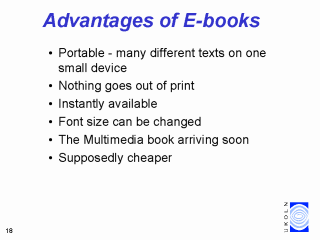
What are the advantages of e-books over print books


punchline:

3.2.6i: Why Librarians would like to purchase more e-books and encourage greater use of them, and their concerns
3.2.6ia: Access
3.2.6ib: Stock Maintenance and Administrative
Tasks
3.2.6ic: Quality of Stock
3.2.6id: Economic Considerations

3.2.6ii: Librarians’ prioritisation of e-book acquisition, with reasons
3.2.6iia: High demand
3.2.6iib: Material types sought
3.2.6iic: Target subjects
3.2.6iid: Specific user groups
3.2.6iie: Constraints
continue reading: What are the advantages of e-books over print books

see also:
  • Advantages of E-books www.ukoln.ac.uk
  • The Benefits and Advantages of Ebooks By Remez Sasson
  • advantages of ebooks
  • Google for more
  • Sunday, June 10, 2007

    Quote of the Day - Good Library is ....


    "The closest we will ever come to an orderly universe is a good library." Ashleigh Brilliant

    Thanks to Gwyn Raven @ Myrddin Wandering for this quote, and for linking all my blogs.

    PS. See more quotations on Library, books, readers, and reading habits @ my blog: Library & Information Science Quotations

    Wednesday, May 23, 2007

    Funny you should ask: Humor at the Reference Desk


    "A short time after returning to librarianship after some years away, I was working at the reference desk . . . When I looked up . . . a young man (approximately college age) was standing there. I asked if I could help him and he said, "Do you have anything on eunuchs?"

    A sample from "Funny You Should Ask: Baffling, Bewildering, and
    Bizarre Questions from the Reference Desk" (Thomson, 2005) (a weekly e-mail column from Gale.com)

    Janis Test of the Abilene Public Library contributed this:
    "Somewhat taken aback, I decided to use my reference interview skills (however rusty) and began asking questions such as "Do you have any particular time period in mind?" and "Are you more interested in harem culture, or castrati?"

    When I noted that he was looking at me as if I were from another planet, I sighed and fell back on the tried and true, "How do you spell that?"

    He rolled his eyes and said patiently, "U-N-I-X." I said, "Oh, exactly," looked it up in the online catalog and directed him to the appropriate part of the library. Once he had gotten out of range, I began laughing and almost literally fell out of my chair. So much for the reference interview." [source: "Al Reynolds" ]

  • True Library stories
  • "Humor is allowed in reference desk answers"
  • Librarian Humor in Classroom and Reference
  • See also: Google
  • Unusual Reference Questions - Globalism Visited
  • Monday, April 23, 2007

    SHARP 2007 - Open the Book, Open the Mind


    Society for the History of Authorship, Reading and Publishing (SHARP)
    July 11-14, 2007 (pre-conference activites July 10), Minneapolis, Minnesota, USA

    The conference theme, “Open the Book, Open the Mind,” will highlight how books develop and extend minds and cultures, and also how they are opened to new media and new purposes. However, individual papers or sessions may address any aspect of book history and print culture. Continue reading

    PS. Info courtesy: Sarah @ Beyond the Job

    Saturday, March 24, 2007

    Go to the library - ways to survive life without the Internet

    An online search may be fast and effortless, but there is nothing like a reference library to make you really appreciate the world of knowledge. Surround yourself in books and get a taste of what it was like to engross yourself in research before the Internet. The process is far more challenging and rewarding." Source: 7 ways to survive life without the Internet

    And, Then The Life Will Be As-Is:


  • Internet and the Future,
    "...the Web’s days are numbered as the Internet moves to a second round of expansion beyond the browser... continue reading"
  • Living beyond Internet, by VAISHNAVI SUBRAMANIAN - Dil Se, The Hindu, Aug 06, 2007
  • Friday, March 23, 2007

    To a Librarian Who Wants to Write - Outside the Box

    "If I were in a position to recommend anything as an addition to the education of librarians, it would be that they write a novel." Michael McGrorty @ Library Dust: A small gift to the library world from Michael McGrorty.


    See my LIS quotations' blog for more on writing, librarians, novels and the world of bookmanship.

    see also:
  • Writing for the Library Profession Presented by: Stephen Abram - Vice President of Innovation for SirsiDynix and Chief Strategist for the SirsiDynix Institute
    Judith A. Siess - Expert in one-person librarianship and interpersonal networking
  • Saturday, December 16, 2006

    Faith's purchasing power - USA TODAY


    By Cathy Lynn Grossman, USA TODAY 12/13/2006
    GRAND RAPIDS, Mich. — In the beginning was the book.

    Long before Christmas became a retail explosion, before Christian-related toys, doodads and décor became a $4.5 billion industry, faithful Protestants needed their Bibles.

    READING ABOUT RELIGION

    When shoppers read books about religion, here's where they say they're most likely to get them:

    A Christian bookstore: 15.9%
    A general bookstore such as Barnes & Noble: 14.8%
    Borrow from a friend or family: 12.2%
    The public library: 9.2%
    A church library: 5.6%
    Other: 5.1%
    Online retailer: such as Amazon.com: 4.4%

    Source: Baylor Religion Survey
    Continue reading the full story


    Previous post from my blogs:

  • Cyber Worship in Multifaith Perspectives
  • Video for the Voiceless: An Idea for Missionaries - Faithwise Review of the Week
  • Multifaith Stacks: Reading Between the Shelves
  •