

Showing posts with label Content Management. Show all posts
Showing posts with label Content Management. Show all posts
Thursday, February 28, 2008


Thursday, February 07, 2008
Library 2.0: Based and Debased
It is heartening to see that Library world is adapting the word: Library 2.0--adapting the word sounds more apropriate because adapting the technology & / or technique of Web 2.0 is not so much obvious. The Word-base is growing, at least if the following is any trend in a Web directory:
Home : Libraries : Library and Information Science : Weblogs : Directories Links:
BlogBib: Select
Librarian/Library Blogs - Annotated list.
BloggingLibraries - Lists by library type, from blogwithoutalibrary.net.
Library Weblogs - Directory categorized by geographic location, compiled by Peter
Scott.
RSS(sm): Rich
Site Services - A categorized registry of library services that are
delivered or provided through RSS/XML, Atom, or other types of web feeds.
The Blog - Overview of blogging for librarians by Rachel Mathieu and Robyn
Fleming. Includes a directory of library blogs.

Also read:
- Library 2.0 Debased by John Blyberg @ blyberg.net [info courtesy: Dr. Francis J Devadason]
- How to find out the best combination of web 2.0 tools and their suitable Library applications, About This Discussion

Started Jan 6 by: F.J.Devadason

NB. Ask for more info about my own presentation on Web 2.0: Challenges for libraries.
Tuesday, November 20, 2007
Outsourcing Libraries - Public Library as a Private Enterprise
"Once known as staid, quiet repositories for books, some institutions are copying business models on how best to attract and keep 'customers.' Jeff Overly "
Outsourcing Libraries: @ OntheCommons.org, Tue, 11/06/2007 , by David Bollier's blog
"There may be no more eloquent statement about the erosion of our civic connectedness than the news that public libraries around the country are starting to outsource their daily operations. Yes, public libraries are being privatized. This should not be entirely surprising, given how jails, highways and even military operations are being privatized these days. Yet it does raise the distressing question – If libraries are vulnerable, where will this momentum for dismantling our civic institutions end? ... http://faithcommons.org/feeditem/outsourcing_libraries
- Google for more on "Outsourcing Libraries" "library outsourced"
 Libraries take a page from business world:
By JEFF OVERLEY, The Orange County Register
The Bottom Line: “library” includes a children’s library, but does not include a library conducted by private enterprise for profit. Source: LIBRARY BOARD OF WESTERN AUSTRALIA ACT 1951 - SECT 3
Monday, October 01, 2007
Enhanced Speed Reading
PS. Interesting application news @ Factiva's "Researcher", info courtesy: Daniela Barbosa and Daniela says: "As promised on Lou's original post, Greg writes about some of the tools that he has been experimenting with which provide capabilities that he is calling 'enhanced speed reading'. His thoughts are based on conversations with information professionals and researchers about how to effectively manage the ever increasing volume of information they need to read."
The following is from Greg's blog:
The following is from Greg's blog:
Concorder Pro: This tool is a bit buggy but I still use it to navigate mini text archives using concordance to browse by words alphabetically or by count. Once you get beyond stop words, it gets very interesting. This app was last updated in 2003 and for OS X mac only. Concordance provides the word counts for every word my mini archive.
Other tools that are also very interesting include:DEVONagent
Concept Q
RefVis
When considering the professional researcher we not only talk about expert search strategies but how the results are really used. Who scans, reads, annotates the ever-increasing overload of relevant information.

Thursday, August 30, 2007
Monday, July 16, 2007
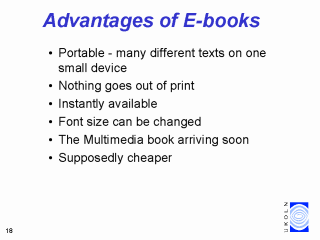
What are the advantages of e-books over print books

punchline:
3.2.6i: Why Librarians would like to purchase more e-books and encourage greater use of them, and their concerns
3.2.6ia: Access
3.2.6ib: Stock Maintenance and Administrative
Tasks
3.2.6ic: Quality of Stock
3.2.6id: Economic Considerations
3.2.6ii: Librarians’ prioritisation of e-book acquisition, with reasons
3.2.6iia: High demand
3.2.6iib: Material types sought
3.2.6iic: Target subjects
3.2.6iid: Specific user groups
3.2.6iie: Constraints
continue reading: What are the advantages of e-books over print books
see also:
Monday, April 23, 2007
SHARP 2007 - Open the Book, Open the Mind

Society for the History of Authorship, Reading and Publishing (SHARP)
July 11-14, 2007 (pre-conference activites July 10), Minneapolis, Min nesota, USA
The conference theme, “Open the Book, Open the Mind,” will highlight how books develop and extend minds and cultures, and also how they are opened to new media and new purposes. However, individual papers or sessions may address any aspect of book history and print culture. Continue reading
PS. Info courtesy: Sarah @ Beyond the Job
Saturday, April 07, 2007
Nine Questions on Technology Innovation in Academic Libraries
In February, 2007, an invitation to an informal survey of "Nine Questions on Technology Innovation in Academic Libraries" was posted to the WEB4LIB, NGC4LIB, LITA-L, COLLIB-L, ACRL-NJ and New Jersey academic library listservs, and it was mentioned in the national ACRLog blog.
The following is a brief summary of the informal survey results with links to more complete information:
***
The survey received 136 responses in total, and 75% said that their library is not the center of technology innovation on campus, while 23% identified the library as the center of technology innovation on campus.
Overall, the majority responded that:
*Recent technology innovations in the library included blogs, wikis, RSS feeds, IM reference, and digitization projects.
*The driving force behind tech. innovation is student needs, followed by an Information Tech. Chief or Dean with vision, and the initiative of individuals.
*The biggest obstacle to tech. innovation in libraries is lack of money, staff, and time, with an unsupportive administration cited as one of the top four obstacles.
*The Library's approach and the Library staff's approach to technology innovation were both overwhelmingly described as "cautious but willing," though the staff were more often described as "resistant and blocking" than the Library itself.
*Faculty and librarians were most cited as the introducers of disruptive technology on campus, followed closely by students.
*The most disruptive technology for academic libraries today is "Web 2.0" or Social Computing technologies with Google/Google Scholar coming up second.
*The Top Ten Models of Technology Innovation cited by the libraries that answered that their libraries are centers of technology innovation were very similar to those cited overall. The Top Ten Models identified were:
1) North Carolina State University – Endeca Project
2) University of Pennsylvania - PennTags
3) MIT – DSpace
4) University of Michigan – Digital Library Production Service (DLPS)
5) University of Minnesota – Primo library system
6) Cornell University – Digital Library Research Projects
7) University of Virginia – Fedora Open Source Institutional Repository 8) University of California – California Digital Library (CDL)
9) University of California, Santa Barbara - Alexandria Digital Library Geospatial Network
10) Oregon State University – LibraryFind Project
For more information on these Top Ten Models of Tech. Innovation in Academic Libraries, links and abstracts are posted on the ACRL-New Jersey Chapter Website
Separate analyses for the libraries that answered "yes" they are the center of technology innovation and the libraries that answered "no"
The overall quantitative results of the survey and the text of the nine
questions are posted online
NB. Info courtesy: Mary A. Mallery @ [Web4lib] & College Libraries Section [COLLIB-L@ala.org ]
Technorati tags:
ACRL
college and research libraries
Saturday, March 24, 2007
Go to the library - ways to survive life without the Internet
An online search may be fast and effortless, but there is nothing like a reference library to make you really appreciate the world of knowledge. Surround yourself in books and get a taste of what it was like to engross yourself in research before the Internet. The process is far more challenging and rewarding." Source: 7 ways to survive life without the Internet
And, Then The Life Will Be As-Is:


"...the Web’s days are numbered as the Internet moves to a second round of expansion beyond the browser... continue reading"
Thursday, March 15, 2007
Provision of Medical Information - Ask Cosmo, NLM’s Virtual Representative!

Al Reynolds [ecumenical77 at earthlink dot net] wrote:
1. "Ask Cosmo" is an automated answer-my-question site at http://wwwns.nlm.nih.gov/
Many questions from the general public can be answered by Cosmo the Owl.
2. Questions may be directed by telephone at the following numbers:
(888) FIND-NLM
(888) 346-3656 Local and international calls:
(301) 594-5983
-------------------------------------------------
Background note: NLM usually received from 200 to 500 requests per day when I was there. Some were library questions ("How to I use PubMed?") but many were cries for medical help ("My daughter has cancer and the medicine isn't working, what can I do?").
I served on the Customer Service staff of the National Library of Medicine for two years. Such questions are constantly being directed to NLM as a free and reputable source of medical information.
There are 7 or 8 full time staff members tasked with responding to such questions. Of course we are not clinicians, so we provide information found on such sites as MedlinePlus and PubMed, and we use directory sites, advocacy organizations and professional associations quite heavily.
You or your patrons may address queries to: custserv@nlm.nih.gov
A response will be sent within 4 working days. NLM does not send printed materials.
During my two years I worked messages originating in 106 countries.
Al Reynolds
Reference Assistant
Frederick Memorial Hospital
Frederick, Maryland
Former contractor at U.S. National Library of Medicine
P.S. This information is disseminated with permission from Al Reynolds.
From the Blogosphere:
Thursday, March 01, 2007
Copyrights and Copywrongs - Responsibility of Media and Academia
P.S. This is not a sequel of Copyrights and Copywrongs: Interview with Siva Vaidhyanathan.
Rather, this is about media (MSN, Yahoo, Google) and academia
IDG News Service (Dublin Bureau) (22 Jan 2007)
Google argued that it doesn't violate copyright because it only summarizes articles and displays the source of the content and the name of the author before directing users to the Web page hosting the content. The judge is expected to rule on the case this month. full story
Google has pledged to tighten its advertising controls after some of the biggest media companies in the US accused it of knowingly encouraging copyright theft. in US media: Google 'encourages copyright theft' By Laura Clout, Telegraph, 13/02/2007

Oh my god not more copyright stuff @ Playing with Technology
See also:
Public Domain Chart
Fair Use Checklist
Related posts from my desktop
Monday, February 19, 2007
The Lessons of T Shirts to Marketers
"One of the problems all of us marketers has is that we lie to ourselves. We want so badly to reinforce what we think we know that we often miss the obvious.
We turn to focus groups and see what we want to see.
We turn to "experts" and hear what we want to hear.
We turn to research to read what we want to read.
We even talk to our customers. Unfortunately, our customers perception of how they interact with our products and services don't alway match reality. No where is this more obvious than at sporting events." Full artilce
Wednesday, February 14, 2007
Wikipedia and Academia Hit News Headlines Again
Poor Wikipedia. Professional Golfer Fuzzy Zoeller is suing one of its contributors for a defamatory cyber-attack. And last year, television host and comedian Stephen Colbert urged his audience to vandalize a Wikipedia entry about elephants to prove the point that in a model where any user can edit encyclopedia entries, those entries are only as good as their source. Look Who's Using Wikipedia, Mar. 01, 2007, By BILL TANCER, Time / CNN [info courtesy, David Dillar]

Current News Stories:
"...places like the blogosphere or the online encyclopaedia Wikipedia, people no longer treat or respect each other as individuals." Web 2.0's 'digital mobs' attacked: Jaron Lanier tells BBC World Service's Culture Shock

Middlebury: Middlebury College history students are no longer allowed to use Wikipedia in preparing class papers.
The school's history department recently adopted a policy that says it's OK to consult the popular online encyclopedia, but that it can't be cited as an authoritative source by students.
The policy says, in part, "Wikipedia is not an acceptable citation, even though it may lead one to a citable source."
History professor Neil Waters says Wikipedia is an ideal place to start research but an unacceptable way to end it. Read another source
As Wikipedia has become more and more popular with students, some
professors have become increasingly concerned about the online,
reader-produced encyclopedia.
From News Archives:
The other side of the coin:
Related resources:
My previous posts:
Monday, January 08, 2007
Picture database recognized as "Best Site"
101 Best Web Sites for Elementary Teachers.
The International Society for Technology in Education has named a Miami database as one of "101 Best Web Sites for Elementary Teachers." (Media-Newswire.com)
Valerie A. Ubbes ( physical education, health and sport studies ) created the Children?s Picture Book Database at Miami University in 1995 in partnership with the Miami University libraries.
The project now provides abstracts for more than 5,000 children's picture books and can be searched by topics, concepts and skills from eight academic disciplines. The key feature of the database is that books are organized by 10-15 key words, not only the few words provided by the Library of Congress. This gives users access to a broader collection of books for specialized purposes, in new patterns for interdisciplinary study.
The site's usefulness can be judged by the fact that thousands of users from the United States and seven foreign countries log into it weekly. "Googling" Children's Picture Book Database at Miami University, 25,000 links come up, including resource lists maintained by universities, schools, libraries, teacher groups, national literacy organizations and businesses catering to parents. Continue reading
Tuesday, October 03, 2006
Web Analytics - A Librarian's Outlook
A while back I’d ranted a bit about some of the troubles I was experiencing with our current web server log analysis package (AWStats) and a commercial package I was test driving at the time (WebTrends). Fortunately, with the installation of the geoip-free plugin for AWStats and a little help from my Perl guru husband, we managed to get a customized domain report from our free web log analysis package while managing to steer clear of a (not free) platform- and browser-specific solution. continue reading

The E-Metrics project is is an effort to explore the feasibility of defining and collecting data on the use and value of electronic resources. Although ARL has some experience in tracking expenditures for electronic resources through the ARL Supplementary Statistics, there is a widely held recognition that more work needs to take place in this area.
Whats making news:
My previous posts
Tuesday, August 08, 2006
Library 2.0 Theory
This is a running post: Updated March 10, 2007:
Michael Stephens on The Culture of Trust
"The best libraries of the future will be those that...will seek to make that personal, emotional connection with users. It might be online, it might be in person, it might even be at Panera Bread. Walk through your library today and look at the story your library is telling with its space, signage, and ambience. Share yourself. Be human. Feel good about the difference you can make in your role as a guide for your users through this crazy, information-inundated world."
Listen to this article ...
Library 2.0 : An Academic's Perspective
I am quite excited to see a fellow SUNY librarian and a nationally known librarian blogging about Library 2.0 from the perspective of an academic. I have known Laura Cohen for may years and have served with her in the SUNY Librarians Association. Her new blog, Library 2.0: An Academic's Perspective, will be worht the time to read it. Her introductory post provides a good introduction and overview of Library 2.0. She quotes this list, from LITA President Bonnie Postletwaite, of what Library 2.0 basic concepts cover:Flexibility and nimbleness to enable rapid change
Commitment to continuous improvement based on assessment
Interactive and collaborative services driven by users needs
Taking the library to the users AND making the library a destination
Embracing radical trust
Use of new technological tools to accomplish the above
Laura then comes to the conclusion that "the last item is optional." I am in complete agreement.
Thanks to Bill Drew @ Baby Boomer Librarian for this reference
Interesting, thought provoking and synchronizing article by Maness. Thanks to Sukhdev for this info.
Library 2.0 Theory: Web 2.0 and Its Implications for Libraries, by Jack M. Maness, Webology, Volume 3, Number 2, June, 2006
Abstract
This article posits a definition and theory for "Library 2.0". It suggests that recent thinking describing the changing Web as "Web 2.0" will have substantial implications for libraries, and recognizes that while these implications keep very close to the history and mission of libraries, they still necessitate a new paradigm for librarianship. The paper applies the theory and definition to the practice of librarianship, specifically addressing how Web 2.0 technologies such as synchronous messaging and streaming media, blogs, wikis, social networks, tagging, RSS feeds, and mashups might intimate changes in how libraries provide access to their collections and user support for that access.
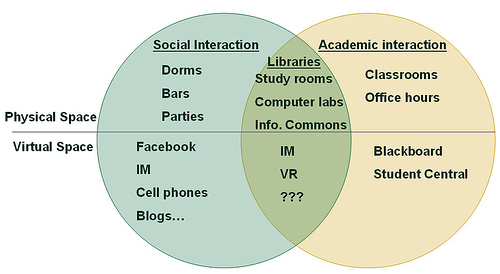
I love this - if you are looking for Library 2.0 ideas for your library, be sure to check out the Library 2.0 Idea Generator. This site randomly generates such gems as:
"remix Ranganathan's Laws using del.icio.us"
"engage microformats using LibraryThing"
"re-evaluate Stephen Abram using the Netflix model"
"repurpose Inter Library Loans just to annoy Michael Gorman"
"A library service on the web that is a combination of LibraryThing, Netvibes, IM-reference and Aquabrowser adapable to the individual needs and of course it should not be library dependent, but could incorporate content and services from all kinds of library-enteties.... Library 2.0 = MyLibrary? by lib1point5, 12 Apr 2006
See Also:
In an article, “Libraries urged to embrace Web2.0″, Mark Chillingworth makes the point that “that existing library catalogue standards, such as MARC and Z39.50, need to be replaced by XML technology “...
Here are some baby steps libraries can take.
1. Decide on what information a library wants to publish - catalogs, events, services, resources etc.
2. Design one or more Microformats for publishing the information
3. Integrate it into the current library web sites
continue reading
Technocrati Tags:
Web 2.0
Library2.0; and Library 2.0
Streaming media
Library Education
See also my previous post:
Sunday, July 09, 2006
Cataloging, indexing Web sites - Librarian's Perspectives
Given below are some samples of
a) how a Web site is catalogued (as input),
b) what descriptors are used (for thruput) and
c) what format is the data available (as output)
NB. If you need any clarification, and / or similar info. on cataloging Web sites, please email me at mt2222 at yahoo.com
Se also:
Metadata is an important aspect of the creation and management of digital images (and other multimedia files). Metadata standards for digital imaging can include information about:
the technical format of the image file
the process by which the image was created
the content of the image
This research explores the capabilities of two Dublin Core automatic metadata generation applications, Klarity and DC-dot. The top level Web page for each resource, from a sample of 29 resources obtained from National Institute of Environmental Health Sciences (NIEHS), was submitted to both generators. Results indicate that extraction processing algorithms can contribute to useful automatic metadata generation. Results also indicate that harvesting metadata from META tags created by humans can have a positive impact on automatic metadata generation. The study identifies several ways in which automatic metadata generation applications can be improved and highlights several important areas of research. The conclusion is that integrating extraction of harvesting methods will be the best approach to creating optimal metadata, and more research is needed to identify when to apply which method.
Hsin-Chang Yang, Chung-Hong Lee, Chang Jung University
The tremendous growth of Web resources has made information organization and retrieval more and more difficult. As one approach to this problem, metadata schemas have been developed to characterize Web resources. However, many questions have been raised about the use of metadata schemas such as which metadata schemas have been used on the Web? How did they describe Web accessible information? What is the distribution of these metadata schemas among Web pages? Do certain schemas dominate the others? To address these issues, this study analyzed 16,383 Web pages with meta tags extracted from 200,000 OCLC sampled Web pages in 2000. It found that only 8.19% Web pages used meta tags; description tags, keyword tags, and Dublin Core tags were the only three schemas used in the Web pages. This article revealed the use of meta tags in terms of their function distribution, syntax characteristics, granularity of the Web pages, and the length distribution and word number distribution of both description and keywords tags.
Thursday, July 06, 2006
Visualizing the Emerging Nexus: Five Laws of Ranganathan and the WWW Era
Given below are three recent attempts (with a focus of first on the Web, Second on hyperlinks, and third on search engines) to reflect samples of the emerging nexus between WWW era and Five Laws. The purpose, here, is to showcase areas where these Laws facilitate a friendly atmosphere in the WWW era.
The most recent attempt to rephrase* the Five Laws comes from Me's blog, and it is called, Ranganathan's Web, posted on June 21, 2006.
ME has very rightly incorporated the WWW era:
Web resources are for use.
Every user his or her web resource.
Every web resource its user.
Save the time of the user.
The Web is a growing organism.
Who can say that creative visualization has reached an end? Information visualization has a new guru, and that is Lennart Björneborn. In his doctoral research entitled, Small-World Link Structures across an Academic Web Space - a Library and Information Science Approach, Lennart goes an extra mile in rephrasing the Five Laws. This is shown below. Apart from this text-based sketch, a full graphic visualization of this in true colors is at his Web site. And, his thesis can also be downloaded from the same site:
Links are for use – the very essence of hypertext;
Every surfer his or her link – the rich diversity of links across topics and genres;
Every link its surfer – ditto;
Save the time of the surfer – visualizing web clusters and small-world shortcuts;
The Web is a growing organism
I did my own attempt to present a mindmap in relation to search engines, as follows:
Search Engines are for Use,
Every Searcher His / Her Search Engine,
Every Search Engine its Searcher,
Save the Time of the Searcher, and
Search Engine is a growing organism.
"The concept of facets was first introduced by Ranganathan in library science to provide – guess what – more flexible navigation of library catalogs. ... Today in Next Generation Search Systems seminar series we had Marti Hearst of UC Berkely. She talked about faceted metadata for navigation." Thus spake Prof. Ramesh Jain, Convergence in Search and databases May 15th, 2006.
Other innovative expressions also show the nexus:
[Thanks to Dr.Sukdev Singh, for this information, at his blog]
I'm glad to see I'm not the only Ranganathan "fangirl". :-)
Continue reading the actual story behind these citations: Jessamyn over at librarian.net reports on this story: Open Access to Ranganathan.
My publications relating to this nexus include:
---
The backend story as it unfolds: In the past, there has been a great appreciation of the works of this Indian guru of Information profession. For example, his mentor, Mr. Berwick Sayers, termed this age as the Age of Ranganathan.*** Another tribute, came from the American Library Association (1964): Your ideas are universal. You answer the challenge of the future with challenge. Most of us are not your disciples, all of us are your students. For a generation you have forced librarians to think. We are proud to be in your debt. Let us change our approach and start reading, learning and experimenting what Dr. Ranganathan has started and written for us. That will be appropriate tribute that we will pay to this greatest professional, scientist of the world.”"*
* The Five Laws, as norms or principles, designed for library service received attention from individuals and professional bodies, alike.
*** reported by Mahmud Hussain, Of Libraries and Librarianship. (Karachi, University Library, 1974), and cited in Libraries and Librarianship in India, by Mohamed Taher and Donald G. Davis, Jr., (Delhi, Concept, 1994): p. 103; Guru Dutt, K. The inwardness of Dr Ranganathan. "Herald of library science", 12 (1973), p. 122; and American revised version of Five Laws, in Ranganathan: A Universal Librarian, by Fazle Kabir, 2003; Gorman, M. (1995). Five new laws of librarianship. American Libraries, 26 (8), 784-785.
Friday, June 30, 2006
Searching Revisited: Horizontal, Vertical, Diagonal, etc.
A word about vertical (or deep), and horrizontal (or surface) Web?
And what are portals doing in this horizontal and vertical world:
HotTopics: Annual Ad Spending Study 2006: Advertisers' Spending And Behaviors In Vertical Industries, Chuck Richard, In Outsell's Opinion
HotTopics: 2006 User Update - How Information Providers Can Keep Pace With User Demands For Time-Saving Solutions, Roger Strouse
TrendAlert: Renewing, Recruiting, Refueling - Hiring And Developing Staff For Information Management Roles,, In Outsell's Opinion
Yahoo! Vertical-Horizontal Integration, Greg Sterling, Search Engine Journal, 7/22/2005
Vertical Search Is Really Horizontal, Recruiting.com, July 20, 2005
The Search Matrix - Horizontal vs Vertical Search,
Horizontal Search / think sideways, thinkerlog, tools for thought
The Multifile Multidisciplinary (Horizontal) Search Approach--Justification and Principles. Jacob Bar, Online Review v12 n1 p47-58 Feb 1988
“horizontal search” initially, “vertical search” now, with when the “diagonal search”? by Didier DURAND, 4/24/2005 Translated version
See also:
Search 2.0 vs Traditional Search Written by Ebrahim Ezzy and edited by Richard MacManus. Ebrahim is lead developer and co-founder of Qelix Technologies, the company behind a search 2.0 contender called Qube. This 2-part series of posts is adapted from Ebrahim's research material in developing Qube.
Time Warner delves into hub market By Bloomberg News
April 5, 1999,
Horizontal is an orientation relating to, or in parallel with the horizon, and the opposite of vertical. A horizontal line goes from left to right (or vice versa) where a vertical line goes from top to bottom.[source: Search.com]
And what are portals doing in this horizontal and vertical world:
Portals can be classified as either ‘horizontal’ or ‘vertical’; a horizontal portal caters to a general audience and provides a broad range of content and services; a vertical portal caters to a niche audience and provides more targeted offerings. [source]
On the Web, a vertical portal (sometimes called a vortal) is a Web site that provides a gateway or portal to information related to a particular industry such as health care, insurance, automobiles, or food manufacturing. (A vertical industry is one that is focused on a relatively narrow range of goods and services, whereas a horizontal industry is one that aims to produce a wide range of goods and services. Because most industry tends to specialize, most industry tends to be vertical.) A term that might also be used is interest community Web site since any vertical industry brings together people sharing an interest in buying, selling, or exchanging information about that particular industry. [source]
The data in this study identify very strong differences in advertising spending and preferences for each vertical industry. Zero in on the findings for the verticals your advertisers are in, and arm your sales team, marketers, and product planners with the hot buttons and non-starters we have identified."
"Vertical search appears to be the wave of the future for professional needs, so build focused subsets of information catering to specific user populations. More is not better; more personalized is. And also realize that “vertical” might mean alignment by job function, industry, subject matter/topic, or other meaningful aggregations that don’t fit the traditional ways information has been assembled."
"Vibrant Information Management staff possess many and varied competencies, and traditional research or librarianship skills are probably already well represented. Make the new required competency the core hiring attribute, with traditional information professional skills as secondary attribute." Roger Strouse
put aside Yahoo!’s FUSE (Find, Use, Share, and Expand) strategy for the moment and look at what the company is doing with vertical and horizontal search (horizontal search being, well, search). Yahoo! recently launched a specialized Travel site to go along with its other vertical sites and content plays.
If you go into Monster you can search jobs up and down the org chart in the Finance Sector. This is a vertical search.
a perspective on how horizontal and vertical seach are a part of a larger search matrix. interesting if google will ever cover all verticals.
Discusses the rationale, principles, required tools, advantages, and disadvantages of the Multifile Multidisciplinary (Horizontal) Search approach to searching online databases. It is noted that this approach is characterized by the use of a large number of files spanning a wide variety of disciplines.
They was the beginnings of the horizontal search engines - “horizontal search engines” - where the objective was to collect a maximum of information - rather of raw data - on the pages of the Web in order to make it possible to the Net surfers to more easily find them by simple keywords...
By the ultimate quality of information which it is judicious to produce, this diagonal research has a potential of valorization financiére enormous, much higher than the Pay-Per-Click keywords. [original source]
Google is currently building what I personally call "diagonal search": i.e., a combination of horizontal and vertical searches (Gnews, upcoming Gase, ravel icons already given here on this blog, etc...) Source: a commnet by Didier DURAND in another blog
Search 2.0 vs Traditional Search Written by Ebrahim Ezzy and edited by Richard MacManus. Ebrahim is lead developer and co-founder of Qelix Technologies, the company behind a search 2.0 contender called Qube. This 2-part series of posts is adapted from Ebrahim's research material in developing Qube.
April 5, 1999,
My previous post:
Searching Is Polarized; Will The Five Laws Get a New Revised Version: Every Search Engine Its Searcher
Thursday, June 22, 2006
Searching Is Polarized; Will The Five Laws Get a New Revised Version: Every Search Engine Its Searcher
This is a running post: Updated 2 Oct, 2006
Is it all-ad-about polarization or an opportunity for libraries for re-invent the
wheel. Read the following and don't miss a survey result: Library Catalogue Users Are Influenced by Trends in Web Searching, Susan Haigh
Search Engines in 2006 are in news:
Thus observes Karen Schneider in her discussion of Top 10 Tech Trends:
Faceted Navigation – “any decent search engine for 2006 has faceted navigation.” Endecca as the example. source More on Faceted Navigation and Guided Navigation, see details
As seen from a recently published work, cited at the end of this article, the demand for library-based Web resources is yet to catch up. "The survey findings indicate that 84 percent of information searches begin with a search engine. Library web sites were selected by just one percent of respondents as the source used to begin an information search."*
Given this state-of-the-art of the library marketing and outreach, let us ponder on what is at stake. It looks like we are not sure of the problem:
Polarization is obvious in this information age. But who is causing and who is facilitating this. Consider the following:
i. Is the free Google-enabled search engine revolution leading the searchers to go astray (than be faithful customers of their own tax-based information centre); or
ii. The fee-based and IP-based (restricted access) offered by the libraries to their own community resulting in this state-of-affairs; or
iii. The libraries have not yet found the true meaning of every book its reader?
And, a related question, then, is about a spirit of live and let live. I think the librarians will consider moving a recommendation for the following as a New Revised Library Liturgy. I hope they will take up, at least, this issue in their respective annual general meeting (wherever it is held):
Search Engines are for Use,
Every Searcher His / Her Search Engine,
Every Search Engine its Searcher,
Save the Time of the Searcher, and
Search Engine is a growing organism.**
I will deal with this polorization in another article. Or, will respond to your comments, based on how you see this whole picture.
Let's now look at a terminological issues about this business of information searching.***
What are the words that express this business?
Supposing one says: online searching and database searching. Is it all about only one activity, viz., online search using the synchronous Web-based resources. Or, is it about first, searching the Web, and second, searching the library resources?
Or, if some one says I am looking for a tool "illustrating the differences between online searching and using the library databases.." Are these terms clear, and communicative or confusing and vague?
Libary of Congress Catalog has a title: online searching (1996).
The subject headings assigned are:
Information storage and retrieval systems--Science.
Information storage and retrieval systems--Technology.
Online bibliographic searching.
Science--Databases.
Technology--Databases.
Another title: Online searching (1990):
The subject headings are:
Online bibliographic searching.
Database searching.
Yet another title: Searching the World Wide Web (1998):
The subject headings are:
Internet searching--Problems, exercises, etc.--Juvenile literature.
Web search engines--Problems, exercises, etc.--Juvenile literature.
In LISA database there is an article with a title: online searching
And the subject headings is:
Online searching
[LISA does not have subject headings, such as, database searching, bibliographic searching, etc]
Incidentally, there is more systematic debate going on on elsewhere and follow that as well.****
Despite this problem with the terminology, I searched the Web for some comparative studies of these two worlds, viz., (a) free domain (WWW), and (b) whatever is facilitated by the libraries. In other words, a) search using the Internet; and b) search using the library-based tools.
And, I have failed (despite Googling, Yahooing, MSNing, AltaVistaing, AllTheWebing, Lycosing, HotWireding, Exciting, etc.) to find any thing specific.
In short, I am looking for a research work that compares online information search with searching the library databases. May be it is too much to expect audio, video, webcasting, blogging, wikiing, podcasting, etc. on this subject. If you know please guide me. I will cite you with personal gratitude.
The Punch Line:
Lest we forget, libraries had all the information at their disposal; and they did try to publish this collection in their own bookish style (Library Websites is a fashion tody). Is it ture that libraries forgot to index the contents, and published a book As-Is? May be. Then the Guru has a verdict for this scenario. Please Note.There is no greater authorial sin than releasing a book without an index. It should even be made an indictable offense. [S.R. Ranganathan in Library Book Selection] source:ALL THE "COOL QUOTES" FROM EX LIBRIS ABOUT LIBRARIES, BOOKS, AND KNOWLEDGE.
--------------
* Making “E” Visible, By Lesley Williams Library Journal, June 15, 2006
Recently OCLC released “Perceptions of Libraries and Information Resources” (www.oclc.org/reports/2005perceptions.htm), a survey of a representative sample of over 3300 online information consumers and their information-seeking behavior. The survey findings indicate that 84 percent of information searches begin with a search engine. Library web sites were selected by just one percent of respondents as the source used to begin an information search. Only two percent of college students start their search at a library web site. In fact, only 16 percent of respondents had ever used an online database and only 30 percent had ever used a library web site. Yet, 72 percent had used free search engines like Google. The report concludes, “…the majority of information seekers are not making much use of the array of electronic resources (online magazines, databases and reference assistance, for example) libraries make available to their communities.” Survey
See also:
PERSPECTIVE Sure, there is plenty of great content on the open Web, but it's far from "everything." Plus, even if what you're looking for has been crawled and indexed by Google or Yahoo, there is no guarantee that you'll create the proper search to have it appear at the top of the results page. To find what you are really looking for, all you need is a library card.
Most searchers only look at the first page of results, and as large Web databases grow even larger it will become even more of a crap shoot to find what you're looking for by just entering a couple of words. Finally, and perhaps most importantly, for many searchers time is a massive issue. In other words, if they can't find it in a few minutes or even seconds, it might as well not exist. Sad but true.
Google Print does not "change everything" regarding the need for professional cataloging and classification of books; its limitations make cataloging and classification even more important to researchers. Google’s keyword search mechanism, backed by the display of results in "relevance ranked" order, is expressly designed and optimized for quick information seeking rather than scholarship. Internet keyword searching does not provide scholars with the structured menus of research options, such as those in OPAC browse displays, that they need for overview perspectives on the book literature of their topics. Keyword searching fails to map the taxonomies that alert researchers to unanticipated aspects of their subjects. It fails to retrieve literature that uses keywords other than those the researcher can specify; it misses not only synonyms and variant phrases but also all relevant works in foreign languages. Searching by keywords is not the same as searching by conceptual categories. Google software fails especially to retrieve desired keywords in contexts segregated from the appearance of the same words in irrelevant contexts. As a consequence of the design limitations of the Google search interface, researchers cannot use Google to systematically recognize relevant books whose exact terminology they cannot specify in advance. Cataloging and classification, in contrast, do provide the recognition mechanisms that scholarship requires for systematic literature retrieval in book collections.
**My previous entries relating to the Five Laws:
a) Save the Time of the Godly: Information Mediators Role in Promoting Spiritual & Religious Accommodation
b) Case Studies from India: Evidence-based Librarianship
c) The Reference Interview Through Asynchronous E-Mail and Synchronous Interactive Reference: Does It Save the Time of the Interviewee?
d) Information Visualization: Innovative Practices to Connect Every Book, Its Reader, A Survey
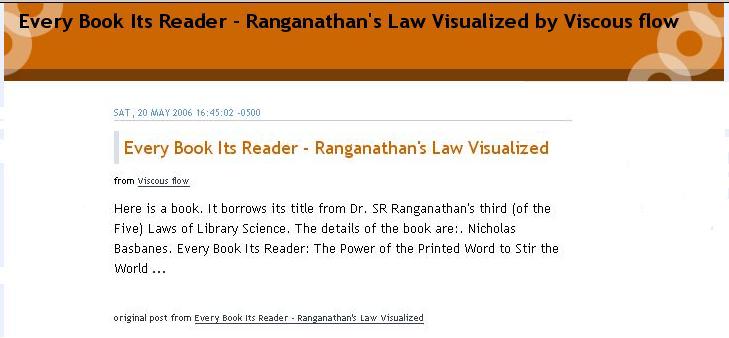
e) Every Book Its Reader - Ranganathan's Law Visualized
***apology for this trivia: words, words and words, all lost in the medium; it is all-ado-about searching, browsing, online, on-line, information storage, information retrieval, thesaurus, indexes, library databases, commercial databases in libraries, free versus fee, etc.
Subscribe to:
Posts (Atom)